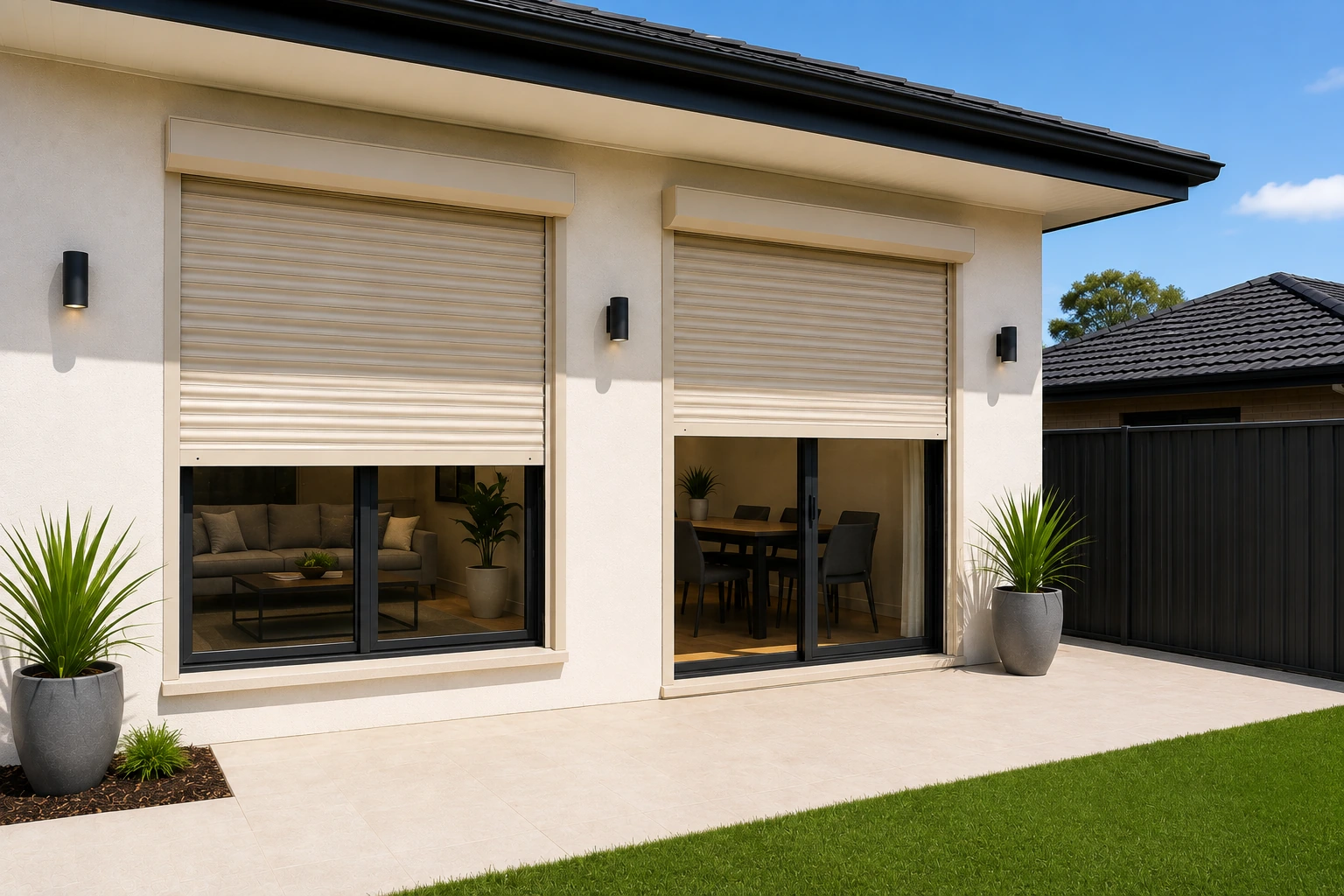
Slimline Roller Shutters Perth WA
A compact residential roller shutter option for Perth homes where privacy, light control, comfort and a neat external appearance are important. Slimline shutters are manufactured in Australia from a precision roll-formed aluminium profile, engineered for smooth, reliable everyday operation.
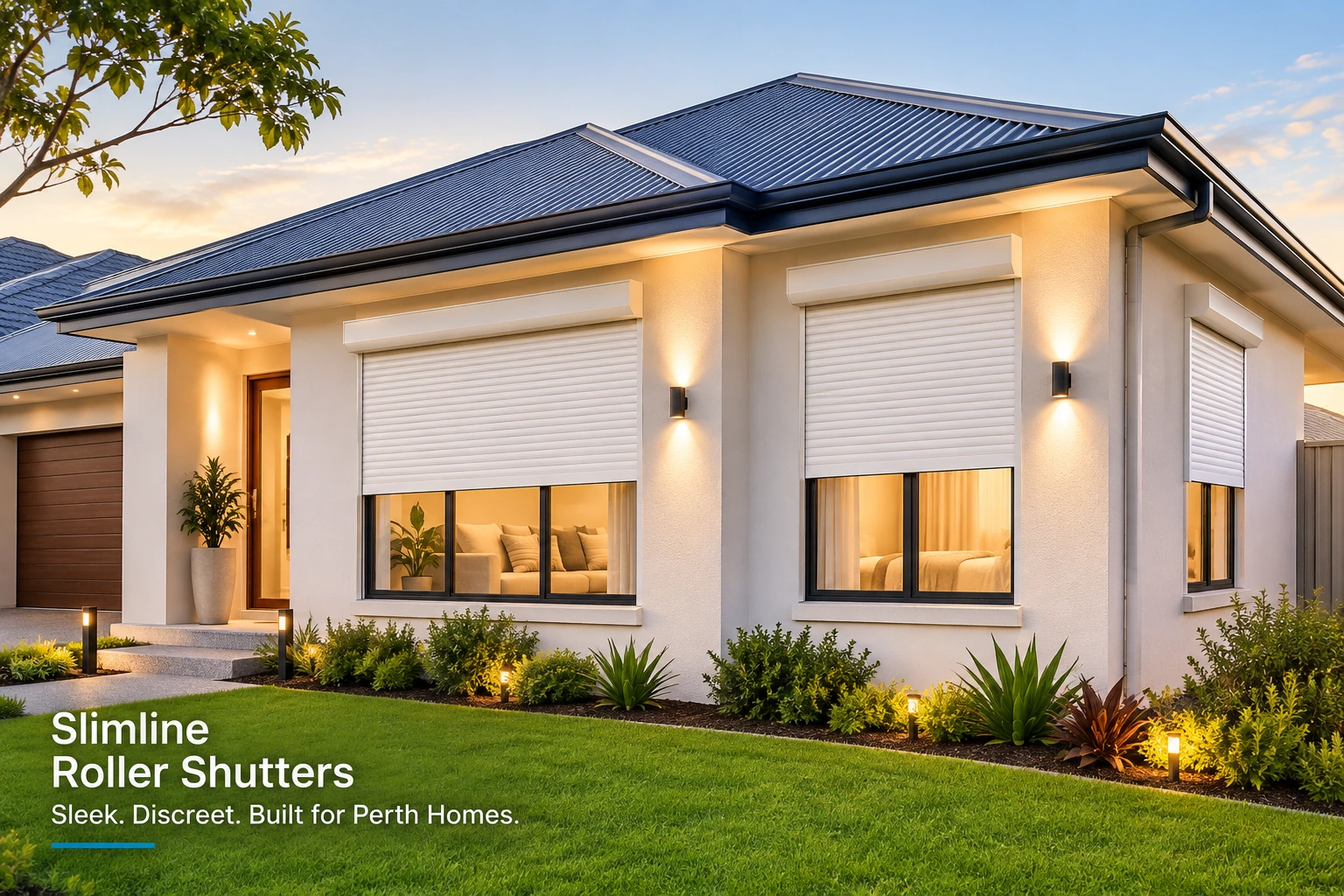
A Slimline roller shutter is a residential aluminium shutter designed to roll into a compact headbox above the opening. It is commonly considered for standard home windows and selected door openings where homeowners want practical everyday control without adding unnecessary visual bulk to the façade. Each installation should be measured and specified for the actual opening, wall construction, access, exposure and preferred method of operation.
Product Highlights
Compact, Low-Profile Design
A neat external appearance without unnecessary visual bulk.
Manual or Motorised Operation
A range of manual and motorised control options to suit different homes.
Engineered for Smooth Operation
Foam-filled profile and sealed bearings support quiet, reliable movement.
Wide Colour Range
A broad range of powder-coated finishes to complement your home's exterior.
Made in Australia
Manufactured locally for Australian conditions.
Professional Installation
Measured, specified and installed for your specific opening.
Why Choose Slimline Roller Shutters?
Slimline systems are often considered by Perth homeowners whose main priorities are reducing direct sunlight entering a room, improving daytime or night-time privacy, controlling unwanted outside light, creating an additional physical barrier over a window, giving bedrooms and living areas more flexible use, and maintaining a neat appearance when the shutter is open.
The correct product still depends on the property. Homes with bushfire, high-wind, coastal corrosion or higher-security requirements may need a different specification.
What Makes a Slimline Roller Shutter Different?
Slimline’s profile is manufactured from a precision roll-formed aluminium curtain, foam-filled for additional strength and smooth, quiet operation. A double-coated and lacquered finish supports abrasion resistance, machine-inserted profile end clips add extra shutter strength, and high-quality internal sealed bearings support smooth, reliable day-to-day movement. The curved, smooth-faced profile and roll-tight design keep the curtain compact and neat when raised — the combination of features that distinguishes a properly engineered residential system from a lighter-duty alternative.
Where Are Slimline Roller Shutters Most Commonly Used?
Slimline shutters may be considered for:
Bedroom Windows
Living-Room Windows
Street-Facing Rooms
Home Offices
Nursery or Children's Rooms
Sliding-Door or Access Openings
Subject to size and engineering suitability.
Older Homes, Renovations and New Builds
Older Perth homes, renovations and newer residential builds where the installation conditions allow.
The site assessment must confirm whether the opening is suitable.
How Slimline Roller Shutters Are Constructed
A typical Slimline roller shutter system includes:
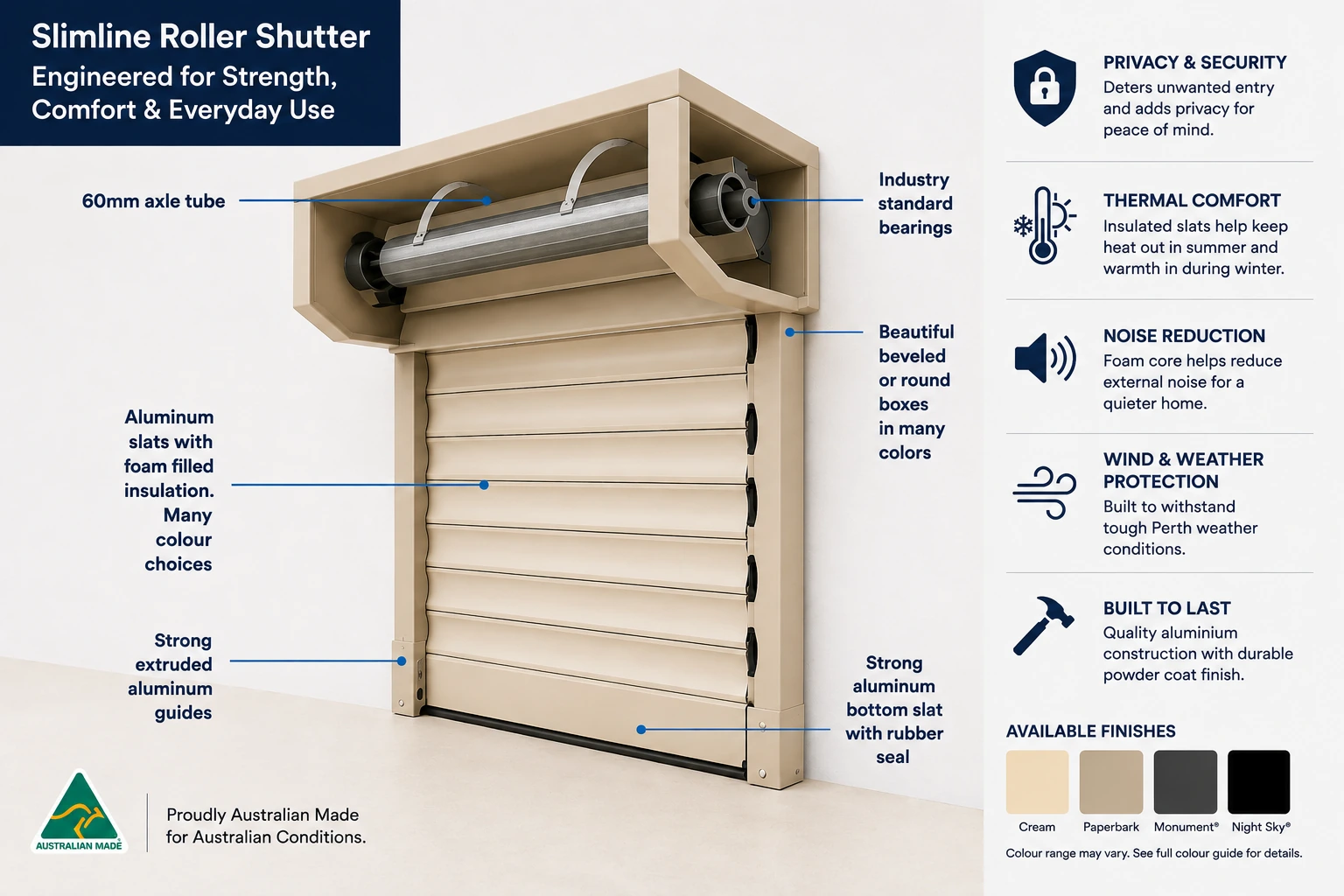
- Aluminium Curtain. Interlocking, foam-filled slats form the moving shutter curtain.
- Headbox or Pelmet. The curtain rolls into the housing above the opening when raised.
- Side Guides. The guides keep the curtain aligned as it travels.
- Bottom Rail. The lower rail finishes the curtain and closes against the sill or base point.
- Operating System. The shutter may be manually operated or motorised, subject to the opening and approved specification.
Each component is selected as part of a complete engineered system — the curtain, guides, headbox and operating equipment are matched together, not substituted individually, consistent with the manufacturer’s own construction approach.
Technical Specifications
Maximum Dimensions
Up to 3600mm wide and 2600mm high, with a maximum surface area of 8m².
Curtain Weight
3.2kg per square metre.
Profile
42mm slat covering, 8.5mm slat thickness, 24 slats per metre.
Axle
Octagonal aluminium or steel, 60mm diameter, fitted with industry-standard sealed bearings.
Bottom Bar
55mm x 8.5mm, fitted with a rubber seal.
Guides
53mm x 22mm standard, with a 68mm x 22mm/15mm guide upgrade available at additional cost.
Headbox Options
Beveled or round headbox/pelmet styles, available in a range of colours.
Finish
Polyurethane/polyamide (PU/PA) painted finish over quality aluminium construction.
Inner Profile Foam
CFC-free polyurethane foam fill.
Origin
Made in Australia (Australian Made Campaign Limited certification).
All dimensions are manufacturer figures, indicative only, and may vary in certain applications — a professional site assessment confirms the specification for your opening.
Colours and Appearance
Colour and finish selection should account for roof and gutter colours, window frames, brickwork/render/cladding, the visual position of the headbox and guides, whether the shutter is reveal fitted or face fitted, and availability within the approved product range.
Previously approved finishes: Cream, Paperbark, Monument, Night Sky.
Manufacturer’s verified profile range (18 colours): Cream, Magnolia Cream, Clear Beige, White, Shale Grey, Brown, Beige, Green, Red, Bronze, Black, Monument, Silver, Deep Ocean, Woodland Grey, Jasper, Surfmist, Dune. Pelmets, side frames, guides and bottom bars are available in a matching but narrower 10-colour range. Powder-coated finishes are available at additional cost, and Coastal Treatment for side frames is strongly recommended for homes near the coast or other salt-water environments.
Only Cream and Monument are common to both lists above. Colour range may vary and current availability should always be confirmed — see the full colour guide for details.
Manual or Motorised Operation?
Manual Operation. A manual system may suit accessible openings where straightforward operation is preferred. Lighter shutters are typically suited to a strap or cord winder or coiler, while a steel cable winder is rated for heavier curtains. A spring-loaded system with a key lock is available where a simple, lockable manual option is preferred.
Motorised Operation. A motorised system may be more convenient for frequently used, larger or harder-to-reach shutters. Homes without convenient mains power access to the opening may suit a 12V system (including a solar-compatible option); homes with standard mains access typically use a 240V wall switch, remote control or key switch, with a crank-handle-with-manual-override option available where a manual fallback is preferred. All control equipment of this kind must be installed in an indoor environment.
Selection should consider: how often the shutter will be used, access to the opening, user mobility, electrical access, the number of shutters, and future maintenance requirements. The specific control option best suited to a given opening should be confirmed during the quotation process, once the curtain size and weight are known.
Key Benefits
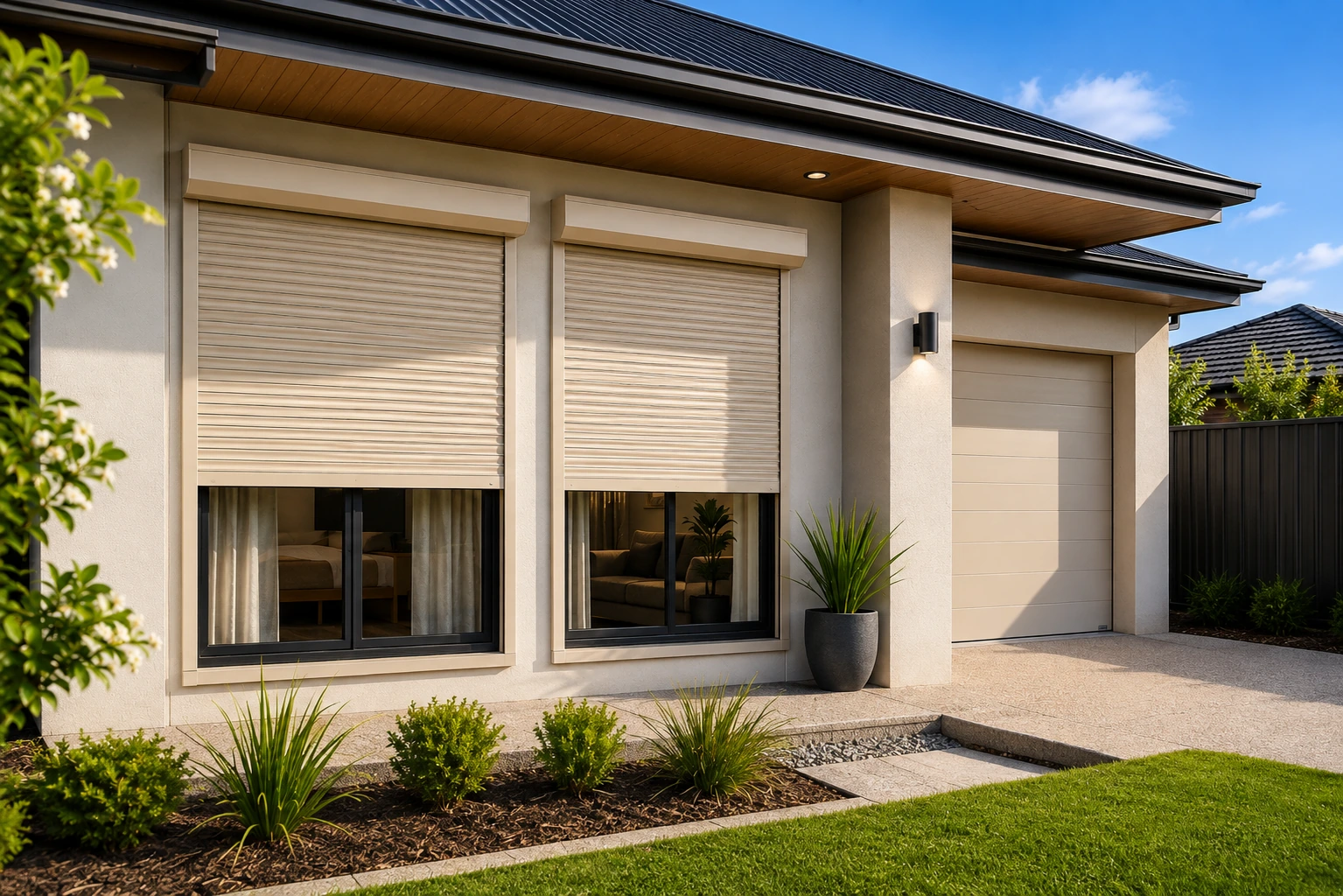
Light Control
Lower the shutter to reduce direct sunlight and darken bedrooms, media rooms or shift-worker sleeping spaces.
Privacy
Control visibility into street-facing and neighbouring rooms.
Heat Management
Reduce direct solar exposure through the covered window as part of a broader home-comfort strategy.
Added Window Protection
Create an additional external barrier over the window or selected opening.
Neat Residential Appearance
The compact housing and guides can be positioned to suit the opening and building conditions identified during assessment.
No benefit is described as absolute or guaranteed.
Design Considerations Before Installation
Two engineering factors specific to Slimline shutters influence what a given opening can achieve:
Pelmet size and maximum height. The pelmet (headbox) size selected determines the maximum achievable shutter height — larger pelmets accommodate more slats and taller openings, up to a maximum of 2600mm at the largest standard pelmet size. Smaller pelmets suit smaller openings and a more compact external appearance.
Wind exposure and maximum width. Achievable shutter width reduces as wind exposure increases. As a general guide, the manufacturer’s engineering data shows maximum width reducing from around 3600mm at low wind exposure to as little as 1700mm in higher-wind conditions. This is why the correct specification depends on the property’s exposure, not on the opening’s width alone.
Both factors — along with wall construction, fixing points, access and the intended method of operation — are confirmed during a professional site assessment, not assumed from the opening’s dimensions alone.
Slimline Roller Shutters in Perth’s Climate
Perth’s climate presents conditions that make external window coverings a practical consideration for many homeowners. Common factors include extended periods of strong summer sunshine, high ultraviolet exposure through much of the year, afternoon heat affecting west-facing windows, and seasonal storms with wind-driven rain.
As an external window covering, a Slimline roller shutter allows homeowners to adjust how much sunlight and heat enters a room throughout the day. The level of benefit depends on the property’s orientation, surrounding shade, window size and how the shutter is used — a site-specific assessment helps determine where the greatest value is likely.
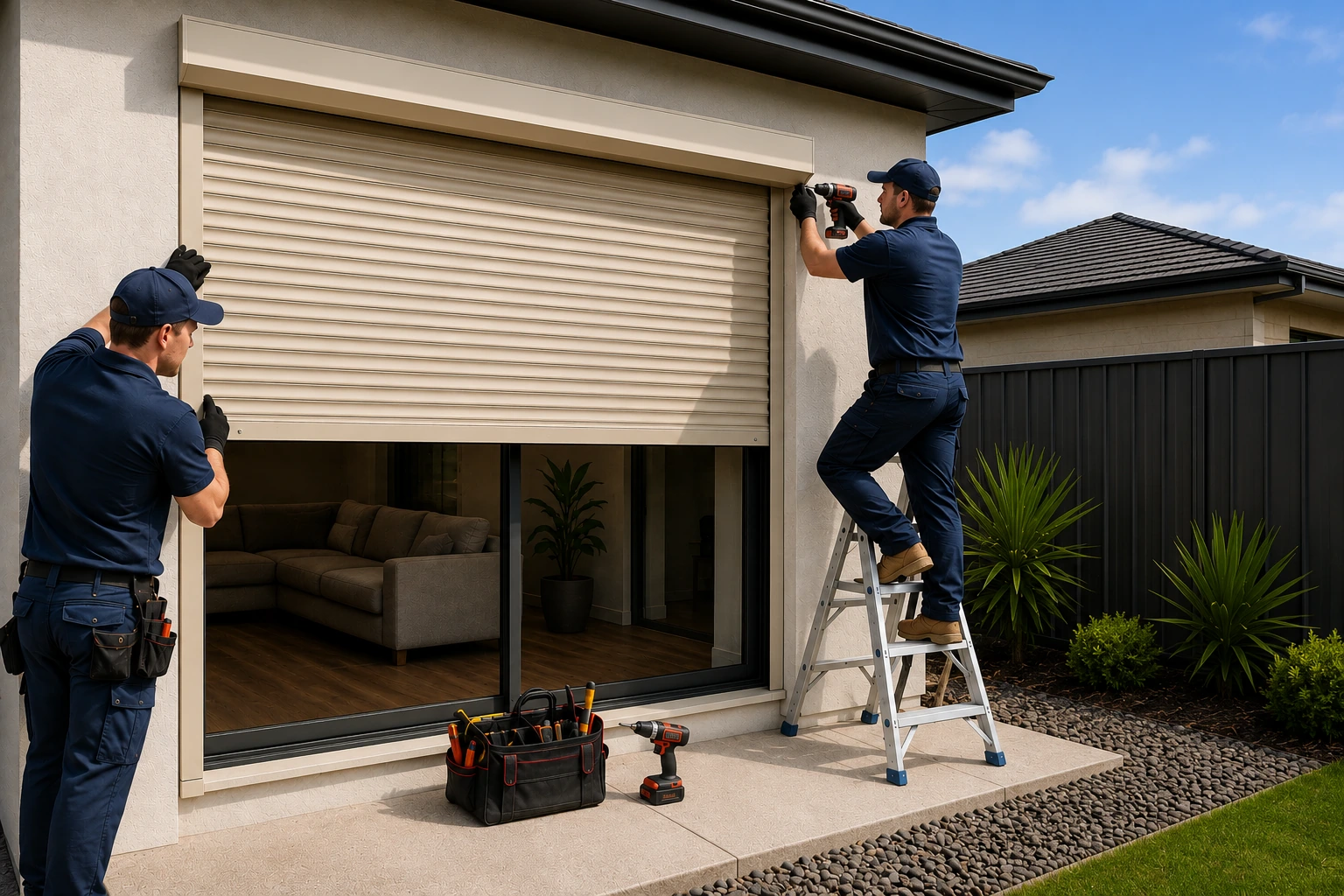
Is a Slimline Roller Shutter the Right Choice?
Slimline May Suit You When
- Reducing direct sunlight entering a room is a priority
- Improving daytime or night-time privacy is a priority
- Controlling unwanted outside light is a priority
- An additional physical barrier over a window is wanted
- Flexible use of bedrooms and living areas is wanted
- A neat appearance when the shutter is open matters
Consider a Specialised Alternative When
- The opening involves larger or wider spans
- Higher wind exposure applies
- Bushfire construction requirements apply
- Stronger forced-entry resistance is required
- The application is commercial or shopfront use
- Visibility through the closed shutter is required
- A project-specific architectural or technical specification applies
Professional Installation Matters
1. Opening Assessment
Inspect dimensions, access, wall construction and surrounding conditions.
2. Product Confirmation
Confirm Slimline is appropriate or recommend another system.
3. Detailed Measure
Record the opening and fixing requirements, including pelmet size and wind exposure where these affect the specification.
4. Manufacture or Preparation
Prepare the shutter to the approved specification.
5. Installation
Fit the headbox, guides, curtain and operating components — for motorised systems, control equipment is installed in an indoor location.
6. Testing and Handover
Check travel, operation and basic care requirements.
Looking After Your Slimline Roller Shutters
Clear Guide Channels
Keep guides clear of dirt and debris.
Avoid Forcing the Shutter
Avoid forcing a shutter that is obstructed or not travelling normally.
Watch for Unusual Movement
Stop using the system if unusual movement or noise develops.
Arrange Inspection When Needed
Arrange inspection when controls, straps, switches, motors or curtain components are not working correctly.
Choosing the Right Slimline Roller Shutter
Once a Slimline roller shutter has been identified as a suitable option, selecting the right specification involves considering:
Opening Dimensions and Pelmet Size
The pelmet size selected affects the maximum achievable height for your opening.
Wind Exposure
Site exposure affects the achievable width — a site assessment confirms the practical maximum for your location.
Manual or Motorised Operation
Based on how often the shutter will be used and the curtain's size and weight.
Colour and Finish
Coordinated with your home's roofline, window frames and façade.
Installation Timeline and Access
Site access and preparation requirements for your specific opening.
Ongoing Maintenance Preferences
Some control options and finishes require different levels of routine care.
A professional site assessment helps confirm the right combination of these factors for your property.
Why Homeowners Choose Perth Roller Shutters & Blinds
Perth Roller Shutters & Blinds helps homeowners compare the available residential systems and select a product that suits the opening, property conditions and practical priorities.
Perth-Focused Product Advice
Residential Roller Shutter Knowledge
Site-Specific Measurement
Professional Installation
Repair and Maintenance Pathways
Clear Product-Fit Guidance
Explanation of when a specialised product should be considered.
Is Slimline the Right Roller Shutter for Your Home?
Arrange a property-specific assessment so the opening, installation conditions and your priorities can be reviewed before the product is selected.
Frequently Asked Questions
Common questions about Slimline Roller Shutters for Perth homes.
They may suit many standard residential windows up to 3600mm wide and 2600mm high, though the achievable size reduces with wind exposure. The opening, wall construction, size, exposure and intended use must be checked before selection.
A closed shutter can substantially reduce incoming light, although the final result depends on the installation and surrounding light paths.
Both are available. Manual options range from strap and cord winders for lighter shutters to a steel cable winder for heavier curtains. Motorised options include mains-powered (240V) and solar-compatible (12V) systems. The right option depends on the shutter's size and weight, confirmed during the quotation process.
Slimline Roller Shutters are available in a range of popular powder-coated colours to complement modern Perth homes. Standard finishes include Cream, Paperbark, Monument and Night Sky. Colour availability may vary depending on the product configuration and current manufacturing options. If you're unsure which finish best suits your home, Perth Roller Shutters & Blinds can help you choose a colour that complements your property's exterior.
Do not assume so. Bushfire construction requirements require a product and installation that meet the applicable project specification. FireShield or another verified solution may be more appropriate.
The exposure and opening size must be assessed. StormShield or another higher-specification system may be more appropriate.
Many faults may be repairable depending on the system, age, components and condition. An inspection is required.
Cost depends on the opening, quantity, installation conditions, operation method and selected specification. A site measure is needed for an accurate quote.