
Outdoor Blinds for Perth Restaurants and Cafes: Extend Your Alfresco Season and Protect Your Revenue
If you run a cafe in Leederville or a restaurant overlooking the river in South Perth, you already know the deal: your alfresco section is your most profitable square metre — until summer arrives and the Fremantle Doctor starts hurling tablecloths across the footpath, or until April showers push your lunchtime crowd back inside. Perth's climate is extraordinary, but it is also genuinely hostile to outdoor dining in a way that most hospitality guides don't talk about honestly.
Over the past few years we've seen a real shift in how Perth venues approach their outdoor spaces. Rather than accepting a seasonal shutdown or throwing canvas market umbrellas at the problem, more operators are turning to purpose-built commercial outdoor blinds — systems designed to handle 40-plus degree afternoons, sustained coastal winds, and the kind of torrential winter rain that dumps 30 millimetres in an hour. The result isn't just a better customer experience: it's a measurable extension of trading hours and covered dining capacity across seasons that would otherwise write off a third of the year.
This guide covers everything a Perth hospitality operator needs to know before buying outdoor blinds for a commercial venue — from the blind types that actually survive our climate, to what councils typically require, to how to calculate whether the investment stacks up for your particular space.
We supply and install across the metro area, from venues in Fremantle's café strip through to restaurant precincts in Subiaco, Leederville, Victoria Park, and the coastal suburbs. If you want a quote specific to your space, the fastest way is a free on-site measure — we'll have a fixed written price back to you within 12 hours.
Why Perth's Climate Makes Alfresco Dining Hard
Perth gets more than 3,000 hours of sunshine per year — one of the sunniest capital cities on earth. That sounds like a hospitality dream, and in the mild months from April through September, it genuinely is. But summer here is brutal for outdoor dining in a way that Melbourne or Sydney operators simply don't face in the same intensity.
Through December, January and February, maximums regularly hit 40°C and occasionally push past 45°C. Unshaded alfresco sections become unusable from mid-morning to late afternoon. UV index in Perth regularly reaches "extreme" ratings — 11 and above — from October through March. Without overhead and side protection, you're not just making customers uncomfortable; you're exposing them to genuine health risks that can damage your venue's reputation.
Then there's the Fremantle Doctor. This is the afternoon sea breeze that sweeps in from the south-west most afternoons between November and March, typically arriving between 1 pm and 3 pm and hitting sustained speeds of 40 to 55 km/h in coastal suburbs like Cottesloe, Scarborough, City Beach, and Fremantle itself. It's cooler than the air mass it replaces, which sounds like a relief — but at those speeds it's a table-wrecking, napkin-scattering, menu-launching nuisance that drives customers inside regardless of temperature. Venues on the Canning River, the Swan, or the Indian Ocean foreshore feel this most acutely. Northbridge and Leederville venues get a version of it too, funnelled through the suburban streets and amplified in any open laneway.
Winter brings a different challenge. Perth's 700-odd millimetres of annual rainfall arrives almost entirely between May and September. A single decent July front can make an open alfresco section completely unviable for a full lunch and dinner service. Without weather protection, that capacity just sits empty — you've paid for the permit, the furniture, the fit-out, and you're getting nothing back for it.
The maths is simple: an outdoor section you can use 12 months of the year is worth dramatically more than one you can use six or seven months of the year.
Types of Outdoor Blinds for Commercial Venues
Clear PVC Café Blinds
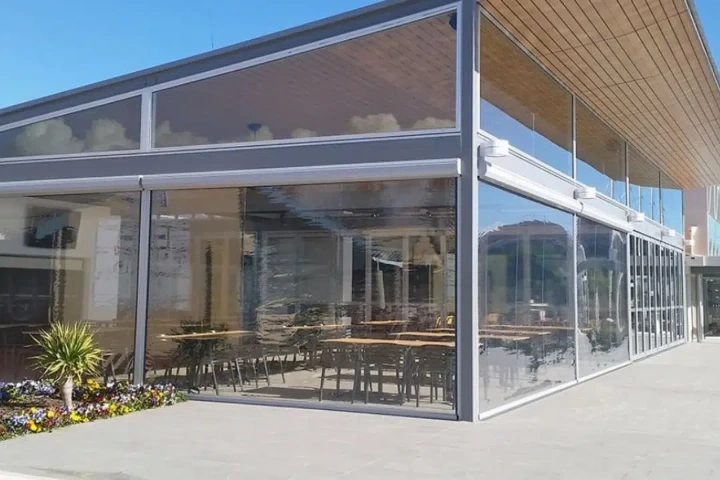
The classic hospitality solution, and for good reason. Clear PVC drop blinds hang from a pelmet or structural track to create a transparent screen that blocks wind and light rain while maintaining the visual openness of your alfresco space. Customers can still see the street, the garden, or the view — they're just no longer being blasted by gusts. For heritage-listed precincts like Fremantle or Subiaco, transparent blinds are often the only option councils will approve, because they don't alter the visual character of the streetscape.
Commercial-grade PVC should be at minimum 1 mm thick and UV-stabilised. Cheaper residential-grade PVC yellows and becomes brittle within two or three Perth summers. Good-quality commercial PVC retains its clarity for 8 to 10 years with reasonable maintenance — wipe clean with a damp cloth after dusty easterlies, and store them retracted during extended periods of strong wind.
Mesh and Screen Fabric Blinds
Woven or knitted mesh fabrics (openness factors typically between 3% and 14%) are the go-to choice when sun control and glare reduction are the primary goals rather than rain or wind exclusion. They can reduce glare dramatically, cut UV transmission by 90-plus percent, and make a west-facing deck usable through afternoon service. Air still moves through the weave, which matters for both comfort and NCC compliance in more enclosed alfresco setups.
For restaurants and cafes on Perth's eastern and western sides — Welshpool, Kewdale, Belmont, Osborne Park, or any venue with strong westerly sun exposure in the afternoon — a quality mesh blind often outperforms PVC because PVC intensifies the greenhouse effect in full direct sun. Some venues run a combination: PVC for the southern and eastern aspects that face the weather, mesh for the western aspect that faces the afternoon sun.
Motorised Systems
At a commercial scale, manual-crank or zip-down blinds become a staffing burden during a busy service. Motorised systems — either hardwired 240V motors or rechargeable battery motors — allow a single staff member to manage the entire outdoor section in under 30 seconds. Most commercial motors can also be integrated with wind sensors, so blinds automatically retract when wind speeds exceed a set threshold. This protects the system during unexpected southerly squalls — which anyone who's worked a summer dinner service in Fremantle knows can come out of nowhere.
For a venue running split shifts with different crew in the morning and evening, motorised systems also eliminate the "nobody knew how to close them" problem that leads to damaged blinds and expensive replacement calls.
Zip-Track and Channel-Guided Systems
Standard drop-down blinds can bow and catch wind in sustained gusts, which is a real problem in coastal and exposed Perth venues. Zip-track systems thread the blind fabric through channel guides on either side of the opening, keeping the fabric under tension and preventing billowing even at high wind speeds. Independent wind-resistance testing on commercial zip-track systems typically rates them to 100–130 km/h — well above what the Fremantle Doctor delivers, and sufficient for most weather events Perth throws at a venue. These are the systems we recommend for venues in Fremantle, Scarborough, City Beach, Cottesloe, and anywhere along the river where wind funnelling is a real issue.
Roller Shutter Integration
Some venues use roller shutters as the primary overnight security closure and weather seal, with outdoor blinds handling daytime shade and wind management as separate layers. This tiered approach works well for venues in Victoria Park, Northbridge, Belmont, and along high-foot-traffic corridors where overnight security is a genuine concern. Our roller shutter range integrates cleanly with most commercial blind systems — see the full shutter range here.
What to Look for in a Commercial System
The outdoor blind market carries a lot of residential-grade product that gets sold into commercial environments where it simply won't survive. Here's what separates a 10-year commercial system from a 2-year domestic one:
Wind rating: Ask for the tested wind speed rating in writing — not a verbal assurance. Zip-track and channel-guided systems should provide written performance data from an accredited test. A standard unsupported drop-down PVC blind has no meaningful wind rating. It's fine for sheltered courtyards and enclosed beer gardens; it's not appropriate for exposed coastal venues or any space with a clear westerly or southerly exposure.
Fabric grade: Acrylic-coated fabrics (Sunbrella, Docril, Soltis, Dickson marine) are industry-standard for commercial outdoor textiles. They're UV-resistant, mould-resistant, wipe-clean, and hold their colour for 10-plus years in direct Perth sun. Cheaper polyester fabrics fade and break down within two or three summers — and when they start degrading they look terrible against an otherwise well-presented venue fit-out.
Hardware grade: Extruded aluminium profiles for tracks and pelmets, stainless-steel fasteners, marine-grade powder coat in coastal locations. Galvanic corrosion between dissimilar metals is a real failure mode within 3 km of the coast — ask your installer what their hardware specification is for your specific location. A supplier who gives you a blank look at this question is not the right supplier for a Cottesloe or City Beach venue.
Motor brands: Somfy and Becker are the two commercial motor brands worth specifying by name. Domestic or unbranded motors fail under the duty cycles a busy commercial venue puts them through — opening and closing 20 to 30 times daily across a seven-day operation adds up fast. Commercial-grade motors from Somfy or Becker carry proper warranties and the spare parts ecosystem to back them up.
Installation warranty: Commercial installations should come with a minimum two-year installation warranty separate from the product warranty. If a supplier can't offer that, keep looking.
Side-by-Side: Blind Types for Hospitality Use
| Blind Type | Best For | Wind Resistance | Rain Protection | UV Control | View Through |
|---|---|---|---|---|---|
| Clear PVC Drop | Budget-conscious, sheltered courtyards, heritage areas | Low (sheltered only) | High | Moderate (heats up in sun) | Fully clear |
| Mesh / Screen Fabric | Sun and glare control, west-facing decks, summer afternoons | Low–Medium | Low (breathable weave) | High (90%+ UV block) | Partial |
| Zip-Track PVC | Coastal venues, high-wind corridors, all-weather enclosure | High (100+ km/h rated) | High | Moderate | Fully clear |
| Zip-Track Mesh | Coastal sun control combined — best of both | High (100+ km/h rated) | Low–Moderate | High | Partial |
| Motorised (any fabric) | Large multi-blind venues, split-shift operations | Medium–High (with wind sensor) | Depends on fabric | Depends on fabric | Depends on fabric |
Extending Your Alfresco Season: The Revenue Case
Let's be concrete about the economics. A Perth café with 30 outdoor seats, $25 average spend per cover, two sittings per service, five days a week — that's around $7,500 per week in outdoor revenue when those seats are in use. Lose even eight weeks per year to extreme heat, wind events, and winter rain and you've surrendered roughly $60,000 in outdoor revenue. Lose six months and the number approaches $180,000. These figures are rough, but the direction is clear.
Quality commercial outdoor blind systems for a mid-sized alfresco area — say 6 metres wide by 4 metres deep, three drops of zip-track PVC with motorised operation — typically sit in the $8,000 to $18,000 range installed, depending on specification and access. At that cost, the payback period on extending your outdoor trading season by even four to six weeks per year is measured in months, not years.
There are also less obvious financial arguments. A weather-sealed alfresco section is a dramatically lower liability risk than an open deck during a storm or extreme heat event. Some venue owners find that properly enclosed outdoor areas affect their insurance category — worth a conversation with your broker before you install, as the outcome can go either way depending on how the enclosure is classified. And a consistent, all-weather outdoor section is simply a better proposition for functions bookings — groups that used to avoid alfresco because of Perth's weather unpredictability become viable customers year-round.
Council Rules and Compliance in Perth
Every Perth local government area has its own outdoor dining permit requirements, and commercial outdoor structures — including fixed or semi-permanent blind systems with aluminium track — can trigger development approval requirements depending on how the council classifies them. This is not legal advice, but here are the practical things to understand before you commit to an installation.
Outdoor dining permits: Most metropolitan councils require an outdoor dining permit for furniture or structures on a public footpath. Adding fixed blind tracks to an existing approved outdoor dining footprint can require a permit variation or amendment. Some councils treat retractable systems more leniently than fixed or permanent structures — check with your council's planning team before signing off on any installation.
NCC (National Construction Code) compliance: Depending on your venue classification and the degree to which an outdoor area becomes enclosed, you may need to consider ventilation, fire egress, and occupancy load for what was previously an open deck. A fully enclosed alfresco section that becomes functionally a room can require assessment under a different NCC classification than an open pergola. If in doubt, get advice from a registered building surveyor before enclosing more than 75% of an outdoor area.
Heritage precincts: Venues in Fremantle, Subiaco, and the City of Vincent heritage precincts face the tightest constraints on outdoor structures. Fixed track systems are often approvable if they use reversible attachments and transparent materials. Coloured or opaque blinds on heritage streetscapes can be refused outright. We work with heritage-area venues regularly and can advise on what material and attachment types have typically been accepted in your precinct before you go to council.
Liquor licensing: In some cases an outdoor entertainment area approval under the Liquor Control Act (WA) defines a specific licensed footprint. Enclosing that area with blinds may or may not affect your licence conditions — worth confirming with the Department of Local Government, Sport and Cultural Industries (DLGSC) if you hold an outdoor entertainment area approval on your premises licence.
Commercial Blind Specifications to Confirm Before You Buy
- Written wind speed rating with test certificate — not verbal assurance
- Fabric brand and grade — specify acrylic-coated commercial textile (Sunbrella, Docril, Soltis) by name
- Hardware specification — marine-grade stainless fasteners in coastal locations (Cottesloe, Scarborough, City Beach, Fremantle)
- Motor brand — Somfy or Becker for venues running commercial duty cycles
- Wind sensor compatibility if motorised, with automatic retract threshold
- Minimum two-year installation warranty in writing, separate from product warranty
- Council permit check completed before installation begins
Frequently Asked Questions
What type of outdoor blinds work best for restaurants and cafes in Perth?
Zip-track systems with either clear PVC or UV-blocking mesh fabric are the best choice for most Perth hospitality venues. Clear PVC zip-track provides full weather sealing and excellent wind resistance — rated to 100-plus km/h in tested commercial systems. Mesh zip-track suits venues where sun and glare control are the primary need and some air flow is desirable. Standard drop-down PVC works in sheltered, low-wind courtyards but should not be specified for exposed coastal venues or any space with a clear westerly or southerly exposure in suburban Perth.
Are outdoor café blinds wind-rated for the Fremantle Doctor?
Zip-track channel-guided systems are specifically designed to handle sustained wind loading — the channel guides keep the fabric under constant tension rather than allowing it to billow. Good commercial-grade zip-track systems are tested to 100–130 km/h, which comfortably covers the Fremantle Doctor's typical sustained speed range of 40–55 km/h in coastal suburbs. Standard unsupported drop blinds have no meaningful wind rating and can become a liability — or a missile hazard — in exposed coastal locations during summer afternoons.
How much do commercial outdoor blinds cost in Perth?
A single drop of commercial outdoor blind for a standard 3-metre opening typically starts from around $800 to $1,500 for a quality manual drop system, rising to $2,000 to $4,000 per drop for motorised zip-track with commercial fabric. A full alfresco enclosure for a café — three or four drops, motorised operation, quality fabric and hardware — usually comes in between $8,000 and $20,000 installed. The exact cost depends on opening dimensions, site access, fabric and motor specification, and whether structural mounting points need to be established. We offer a free on-site measure with a fixed written price within 12 hours.
Do I need council approval to install outdoor blinds on my café or restaurant?
It depends on your local government area and whether the blinds are on private property or extend over a public footpath. Fixed track systems generally attract more scrutiny than removable systems. Heritage precincts (Fremantle, Subiaco, City of Vincent) have additional overlay requirements around materials and attachments. We recommend checking with your council's planning team before committing to any installation — we can also advise on what has typically been approved in similar nearby venues to help you have a more informed conversation with the council.
Get a Free Commercial Measure and Quote
We'll visit your venue, assess your alfresco space, and have a fixed written price back to you within 12 hours. No obligation, no hard sell — just a clear number so you can make the right call for your venue.
Book a Free Site Visit See Our Shutter RangeSources and Further Reading
- Bureau of Meteorology — Western Australia — Perth climate data including temperature extremes, UV index, and Fremantle Doctor wind patterns
- Australian Building Codes Board (ABCB) — publisher of the National Construction Code, which governs commercial building classifications and enclosed alfresco compliance
- Department of Local Government, Sport and Cultural Industries (DLGSC WA) — liquor licensing in Western Australia, including outdoor entertainment area approvals
- WA Department of Energy, Mines, Industry Regulation and Safety — building and energy regulation in WA, including commercial building approvals