
Myth Busted: Not All Roller Shutters Are the Same
It's one of the most common things we hear from Perth homeowners who've been shopping around: "they all look the same to me, so I may as well go with the cheapest." It's an understandable conclusion. From the street, most roller shutters do look similar — a curtain of horizontal slats that rolls up into a pelmet box above the window. But what's inside the slat, how the profile is shaped, what the coating can handle, and what the shutter was designed to do are all very different stories depending on what you're buying.
The difference matters more in Perth than most places in Australia. When summer temperatures push past 40 degrees in Dianella, Midland, and Canning Vale, a foam-filled slat and a hollow one sitting side by side on the same window will produce measurably different interior temperatures. When the Fremantle Doctor is doing 45 kilometres an hour and rattling everything on the patio, the quality of the guide seals and the weight of the curtain determine whether your shutter holds steady or makes the whole bedroom sound like a tin shed.
And if you live within a couple of kilometres of the coast — Cottesloe, City Beach, Scarborough, or Fremantle itself — the powder coat and substrate grade on your shutters will determine whether they look good in fifteen years or start pitting and chalking in eight.
Below I've broken down the six areas where roller shutters genuinely differ from each other, and what those differences mean for Perth homes specifically. If you're comparing quotes and they're all coming in at different prices, this is the guide that explains why.
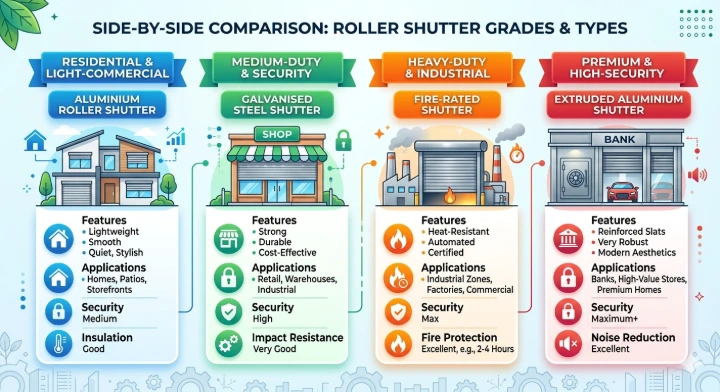
The slat profile — what's actually inside the shutter
The myth A slat is a slat. They're all aluminium and they all do the same thing.
The reality Roller shutter slats vary in wall thickness (the gauge of the aluminium), profile shape, and whether they contain foam fill. These three factors determine the shutter's weight, rigidity, thermal performance, noise attenuation, and resistance to deformation under impact.
Entry-level shutters use thin-walled hollow profiles — lighter, cheaper to manufacture, and adequate for applications where you just want basic light control and privacy. Mid-range and premium profiles use foam-filled slats, where polyurethane foam is injected into the aluminium extrusion. The foam adds structural rigidity (a foam-filled slat is harder to bow under pressure), improves thermal resistance significantly, and reduces noise transmission through the shutter.
In Perth's climate this isn't a trivial distinction. A double-brick home in Karrinyup with foam-filled shutters on the west-facing windows will hold interior temperature noticeably better during an afternoon that hits 42 degrees than the same house with hollow slats. The foam acts as an insulating barrier that slows heat transfer through the closed curtain. Hollow shutters help — they're still better than uncovered glass — but they don't come close to the thermal performance of a foam-filled profile.
Slat wall thickness also matters for security. A thicker-gauge slat resists forced entry better. The profile shape — particularly whether the bottom rail is reinforced — determines how well the shutter resists being levered from the bottom, which is a common entry technique. Two shutters that look identical from the outside can have meaningfully different security characteristics based purely on the profile specification.
Security ratings — not all shutters deter break-ins
The myth Any roller shutter will stop a break-in. They're all metal, so they're all secure.
The reality An untested, light-gauge shutter installed without proper locking can be defeated faster than a determined intruder would take to break a standard window. The deterrence value is real, but the degree of deterrence varies considerably.
Genuine security shutters use heavier-gauge aluminium profiles, reinforced bottom rails with hardened steel locking bars, and guide channel designs that resist the shutter being lifted or pushed inward. Some are independently tested against forced-entry techniques. A shutter marketed as "security grade" without supporting specifications or test results is a marketing claim, not a guarantee.
This matters in Perth. WA Police statistics consistently show that residential burglaries in outer-corridor suburbs — Ellenbrook, Baldivis, Byford, Gosnells — are disproportionately high relative to the metro average. Homes in these areas that install shutters primarily for security should be specifying a product designed for that purpose, not a standard residential shutter purchased on price.
Our Defender Roller Shutter is specifically built for security-first applications — heavier profile, reinforced locking, and the kind of resistance specification that matters when deterrence is the primary goal.
Thermal performance — some insulate, some barely help
The myth Roller shutters keep the heat out. Job done.
The reality Roller shutters reduce solar heat gain through windows, but the degree to which they do that depends heavily on the slat profile, how tightly the shutter closes, and whether there are gaps in the weather seal.
The primary mechanism is solar reflectance — a closed shutter, particularly a light-coloured one, reflects radiant heat before it passes through the glass. Even a hollow shutter does this reasonably well. The secondary mechanism is conductive insulation — slowing the transfer of heat through the closed curtain itself. This is where foam-filled shutters significantly outperform hollow ones.
A third factor that's often overlooked is the weather seal. A shutter with gaps along the guide channels or a worn bottom seal creates convective pathways — hot air from outside moves through the gap, negating some of the thermal benefit. A well-sealed, foam-filled shutter on a Perth north or west-facing window can reduce solar heat gain through that window by over 80 percent. A hollow, poorly-sealed shutter might achieve 50 to 60 percent. On a 43-degree day in Thornlie or Welshpool, that gap is felt.
If energy efficiency is a primary reason you're installing shutters, ask suppliers specifically about slat R-values and sealing quality — not just "does it block the heat."
Coastal durability — coatings and corrosion resistance
The myth Aluminium doesn't rust, so all roller shutters are fine near the coast.
The reality Aluminium doesn't rust in the iron-oxide sense, but it does oxidise, pit, and lose its paint system when exposed to salt air — and the rate at which it does so depends entirely on the quality of the powder coat and substrate treatment.
Perth's coastal suburbs sit within a high-corrosion zone. Within roughly two to three kilometres of the ocean — Cottesloe, City Beach, Floreat, Scarborough, Fremantle, Wembley — the salt aerosol concentration in the air is substantially higher than it is ten kilometres inland. A shutter installed in Morley with a standard powder coat may look new after fifteen years. The same shutter installed in Cottesloe may show chalking and pitting in eight.
Quality coastal shutters use higher-spec powder coat systems applied over a properly prepared and pre-treated aluminium substrate. The fixings and hardware should also be stainless steel or zinc-coated rather than standard steel. When you're getting quotes for a coastal property, confirm the coating specification in writing — "suitable for coastal use" as a verbal assurance is not the same as a documented product specification.
This is also worth noting for inland suburbs that experience high dust and UV exposure — Midland, Malaga, Balcatta, Kewdale. UV degradation of powder coats is a different failure mode to salt corrosion but is equally affected by coating quality and application standards.
Operation type — more than just convenience
The myth Manual or motorised is just a lifestyle choice. Both options work the same way.
The reality The operation type affects how consistently the shutter is used, how tightly it closes each time, and what happens when the Fremantle Doctor arrives at 3pm and you're not home.
Manual strap shutters are the most common entry-level option. They work reliably and have no electronics to fail. But there are practical limitations: a strap shutter on a tall window requires significant pull force to raise, and many homeowners in Subiaco and North Perth retrofitting older homes find that the straps become inconvenient enough that the shutter stops being used consistently. A shutter that isn't used isn't protecting anything.
Crank-operated shutters use a side-mounted handle mechanism and are generally easier to operate smoothly, making them a better choice for heavier curtains or taller windows without going to the cost of motorisation.
Motorised shutters can be operated by wall switch, remote, or integrated into home automation. For households with mobility constraints, for high windows, or for people who want to schedule shutters to close before the afternoon heat builds — motorised is genuinely the superior option, not just a luxury. It also means you can close shutters from outside the house (via remote) when you notice the Fremantle Doctor coming in — something that's not possible with a strap shutter once you've left the property.
Specialist shutters — fire, wide-span, and perforated
The myth There's a standard roller shutter and that's all you need for any situation.
The reality Several applications require a shutter specifically designed for that purpose — and using a standard shutter in those applications is either ineffective or non-compliant.
Fire-rated shutters
Homes in bushfire-prone zones in Perth's outer corridor — Byford, Serpentine, Yanchep, parts of Ellenbrook — may be subject to Bushfire Attack Level (BAL) requirements under the National Construction Code. Fire-rated shutters are designed to resist ember attack and radiant heat for a specified period. A standard roller shutter does not provide this protection regardless of how robust it looks. Our Fire Shield Roller Shutter is specifically rated for bushfire applications.
Wide-span shutters
Standard roller shutter profiles have practical span limits — the wider the opening, the more the curtain can bow or sag in the centre without proper profile engineering. For garage-width openings, bifold door spans, or commercial roller doors, a purpose-built wide-span profile is required. Our SupaSpan Roller Shutter handles wide openings without the sag and guide tracking issues that occur when a standard profile is stretched beyond its design width.
Perforated and vision shutters
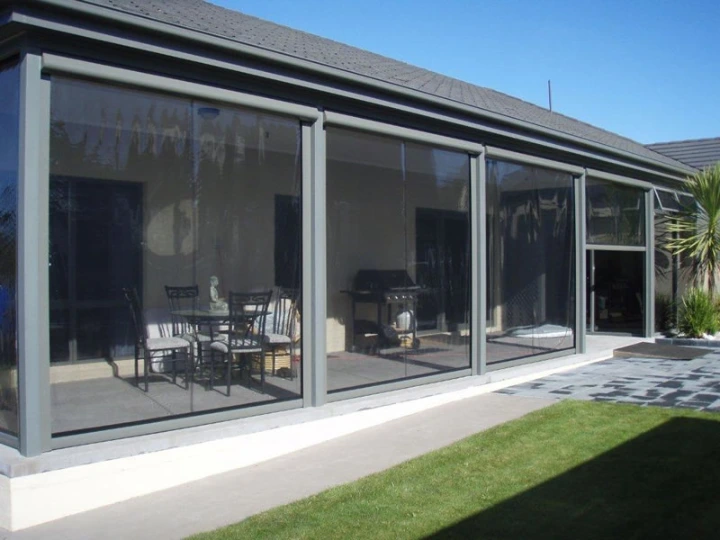
Solid slat shutters block all light and outward visibility when closed. For applications where you want natural light, ventilation, or the ability to see out while maintaining privacy from the street — alfresco areas, street-facing living rooms, shopfronts — a perforated profile is the correct specification. Our Vision Roller Shutter uses a perforated slat that passes diffused light and allows visibility from inside while remaining opaque from the street.
How to choose the right shutter for your Perth home
The starting point isn't the shutter — it's the application. Work backwards from what you actually need the shutter to do:
| Primary Goal | What to Prioritise | Relevant Product |
|---|---|---|
| Home security / break-in deterrence | Heavy-gauge profile, reinforced bottom rail, tested locking | Defender Roller Shutter |
| Summer heat reduction | Foam-filled slats, tight weather seal, light colour option | Standard or security profile with foam fill |
| Light control + some visibility | Perforated slat profile | Vision Roller Shutter |
| Wide openings (garage, bifold, commercial) | Wide-span rated profile, heavy-duty guides | SupaSpan Roller Shutter |
| Bushfire-prone zone compliance | Tested and rated fire shield profile | Fire Shield Roller Shutter |
| Coastal property (within 3km of ocean) | High-spec powder coat, stainless or zinc hardware, sealed profiles | Any profile — confirm coastal spec in writing |
| Heritage or narrow-reveal facade | Compact pelmet profile that fits tight reveals | Discuss at measure and quote — we'll advise on fit |
It's also worth asking about warranty terms. A shutter backed by a manufacturer's warranty on the profile and a separate installation warranty on the labour tells you the supplier is confident in both the product and the workmanship. A vague "we'll come back if something goes wrong" is not the same thing. You can review our warranty approach on the warranty page, and check the FAQ for common questions about product specifications and comparisons.
Not sure which shutter is right for your home?
We measure and quote across all Perth metro areas — and we'll tell you exactly which profile fits your application, your opening, and your budget. No pressure, no vague answers.
Get a Free Quote View Our Range- WA Police Force — Crime statistics — suburb-level residential burglary data referenced in the security section
- Bureau of Meteorology — Perth climate averages — temperature and UV data underpinning thermal and coating performance claims
- Australian Building Codes Board — Bushfire Attack Level (BAL) — NCC requirements for bushfire-prone construction zones
- Housing Industry Association WA — WA housing construction and renovation activity data